
I’ve spent years teaching skiing and working in ski shops, and one thing I’ve never particularly liked is the obsession with ski length.
You’ll hear people insist they need a 170cm ski because that’s what they’ve always used. Or that anything above their head is far too long.
I’ve even had customers worry about moving up just 2cm, as though their new skis might suddenly become impossible to turn.
But here’s the thing. Two skis of exactly the same length can feel completely different. And sometimes, a longer ski can actually feel easier to handle than a shorter one.
There’s a lot more going on than the number printed on the topsheet.
A 180cm Ski Can Feel Shorter Than a 160cm Ski
Sounds backwards, doesn’t it?
Imagine you’ve got a traditional 160cm carving ski and a heavily rockered 180cm freeride ski.
The shorter ski has plenty of camber, with its contact points extending quite far towards the tip and tail. The longer ski has substantial rocker at both ends, lifting more of the base away from the snow.
Despite being 20cm longer overall, the freeride ski could have less of its base contacting firm snow when flat.
That’s what this diagram is showing.

The longer ski still has more material, more swing weight and potentially greater flotation. It hasn’t magically become a short ski.
But with less of the base contacting the snow, it may be easier to pivot or release from a turn than you’d expect.
This is one reason I don’t get too worried about the length of heavily rockered powder skis. They can be surprisingly manageable, even when they look enormous standing in the ski shop.
Effective Edge Matters Too
There’s another measurement worth knowing: effective edge.
This is the usable metal edge running along the ski’s sidecut, between the contact points near the tip and tail.
A longer effective edge generally gives you more potential grip and stability on firm snow. A shorter one can make a ski feel easier to pivot, particularly when combined with rocker.

It’s not quite the same as contact length, which is the measurement illustrated above.
I’ve explained the difference properly in our effective edge guide, including how it works for snowboards.
The important bit here is that overall ski length tells you surprisingly little about how much edge you’ll actually be using.
Rocker Changes How Long a Ski Feels
If you’ve ever switched from traditional piste skis to modern freeride skis, you’ll probably know what I mean.
A heavily cambered ski tends to feel planted and precise on firm snow. A ski with plenty of rocker can feel much looser, especially when you’re pivoting through chopped-up snow or making quick direction changes.
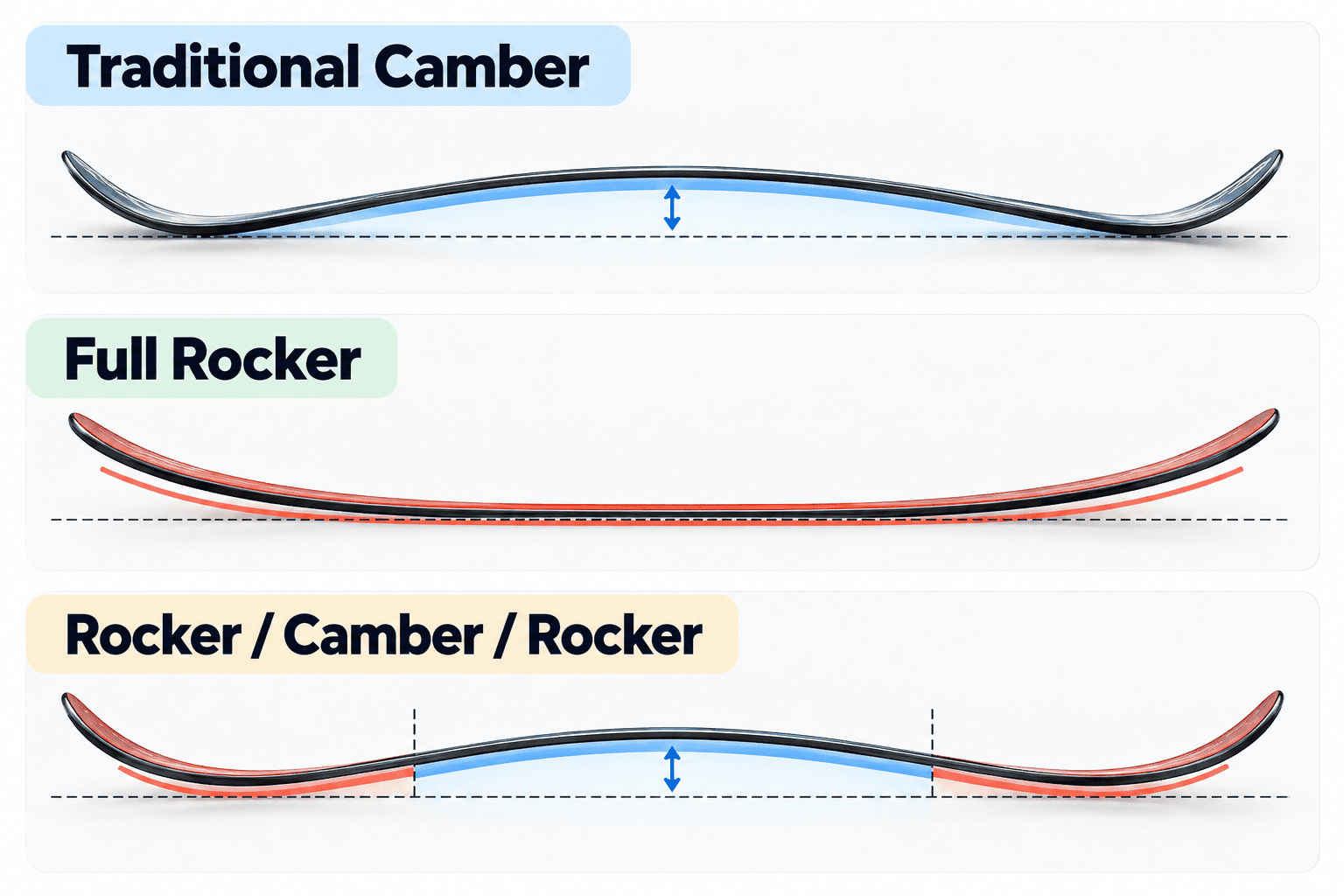
I’ve noticed this most when moving between piste and powder setups. The longer freeride skis don’t necessarily feel harder to manoeuvre, despite having considerably more ski in front of me.
And once you’re in deeper snow, that extra length becomes useful. More surface area helps with flotation, while the rocker helps the ski rise through the snow.
That’s why I’d happily ski something significantly longer for powder than I would for carving groomers.
If you’re not familiar with the different profiles, I’ve covered ski camber versus rocker separately.
Don’t Forget Sidecut and Flex
Length and rocker aren’t the whole story.
Sidecut affects how naturally a ski wants to turn when it’s on edge. A deep sidecut generally produces a shorter turn radius, while a straighter ski tends to favour longer arcs.
I’ve skied relatively long piste skis that felt incredibly responsive because of their sidecut. Equally, some shorter freeride skis can feel reluctant to carve a tight turn.
Then there’s flex.
A stiff ski might feel demanding at slower speeds, especially if you aren’t putting enough pressure through it. A softer ski can be easier to bend into a turn, although it may feel less composed when you’re really pushing it.
Construction, width and weight all contribute too.
This is why I always find it a little tricky when someone asks whether a particular ski length is too long without mentioning which ski they’re talking about.
A 175cm slalom-inspired ski and a 175cm powder ski are completely different propositions.
So How Long Should Your Skis Be?
I’m not suggesting you ignore ski length altogether. It’s still important, and going excessively short or long can absolutely make skiing harder.
But I’d choose length based on the type of ski and how you actually intend to use it.
As a general starting point:
Beginner piste skier: A slightly shorter, forgiving ski is usually easier to control while learning.
Intermediate all-mountain skier: Somewhere around chin to forehead height is a reasonable starting range, depending on the ski. Although I still hate this method of sizing up skis!
Advanced piste skier: Longer lengths can provide more stability, but sidecut and stiffness are just as important.
Powder and freeride skier: Going longer often makes sense for flotation, particularly with heavily rockered designs.
These are guidelines, not rules.
Our ski size calculator can help you narrow down a sensible starting length based on your height, weight, ability and skiing style.
But once you’ve got that number, look at the actual ski. Its shape and construction might justify sizing up or down.
And if you’re buying something substantially different from what you’re used to, I’d always recommend demoing it if you get the opportunity.
What I’d Actually Look For
When I worked in ski shops, I’d much rather know where someone skied, how aggressively they liked to turn and what they struggled with than hear their preferred ski length straight away.
That information tells me considerably more about what might suit them.
Someone who spends most of their time carving on icy groomers probably doesn’t need a long, heavily rockered freeride ski. Equally, someone heading to Japan for deep powder shouldn’t automatically rule out a longer ski just because it looks intimidating.
Start with the type of skiing you do, then work backwards to the right ski and length.
I’ve ridden plenty of skis that looked perfect on paper and felt awful once I got them on snow. And others that seemed completely wrong for me until I actually tried them.
Length matters. Of course it does.
It just doesn’t tell the whole story.

