
I’ve skied a lot of different skis over the years, from traditional cambered piste skis to heavily rockered powder skis. And while there’s plenty of marketing nonsense surrounding ski design, the shape of a ski genuinely makes a difference.
You can have two skis of similar length and width that behave completely differently on snow, largely because of their profiles.

If you’ve ever wondered what camber and rocker actually mean, or whether you should care, here’s how I look at it after years of skiing and instructing.
What Is Ski Camber?
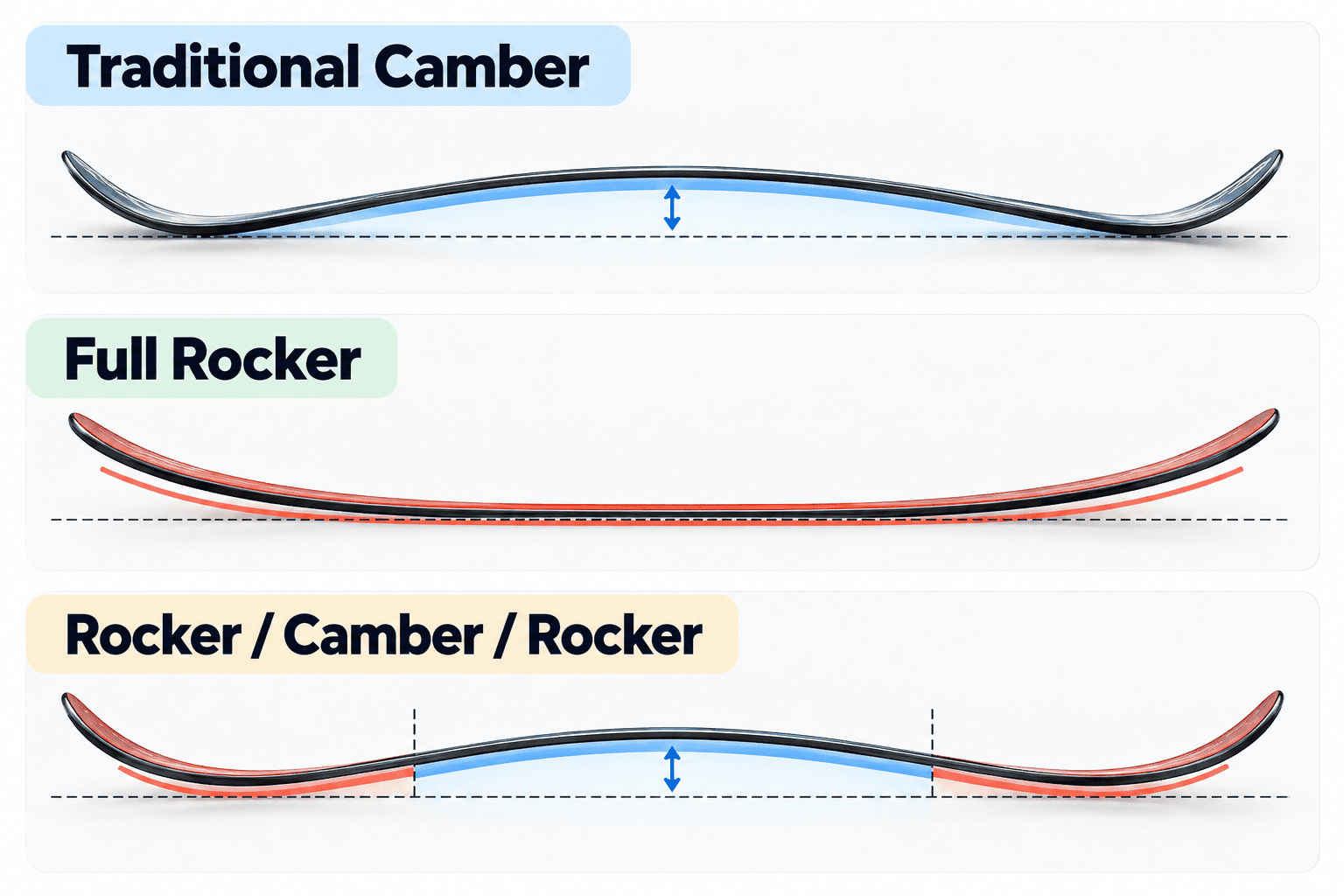
Camber is the traditional ski profile. Put a ski on a flat surface without any weight on it, and you’ll notice that the middle sits slightly off the ground, while the ski makes contact with the surface further towards the tip and tail.
When you stand on the ski, your weight flattens that arch, helping distribute pressure along the edge.

There’s a reason camber has been around for so long. It works.
On firm snow, cambered skis generally offer excellent edge grip, stability and energy coming out of a turn. Load the ski up through a carve and you’ll feel it spring back as you release the pressure.
As an instructor, I’ve always liked that response. A good cambered ski gives you plenty of feedback about what your edges are doing.
The downside is that traditional camber can be less forgiving, particularly for beginners. There’s more effective edge to manage, and poorly timed movements can result in an unwanted edge catch.
It’s also not particularly helpful for flotation in deep powder. That’s where rocker comes in.
What Is Ski Rocker?
Rocker is essentially the opposite of camber.
Instead of arching upwards in the middle, a fully rockered ski curves upwards towards the tip and tail, with the central section sitting closer to the snow.
You’ll sometimes see it called reverse camber.

The biggest advantage is in soft snow. Rocker helps the tips rise through powder rather than digging underneath it, making the ski easier to pivot and manoeuvre.
I particularly notice the difference in deep snow and tight terrain. Heavily rockered skis can feel incredibly loose and playful, allowing you to change direction with relatively little effort.
But that loose feeling isn’t always what you want.
On hardpack, full rocker generally offers less effective edge contact than a traditional cambered ski. Depending on the design, you can lose some precision, grip and stability when you’re really pushing through a carve.
That’s why I wouldn’t choose a fully rockered powder ski for a week spent mainly carving groomed pistes.
You can certainly ski one on hard snow. It’s just not where that design tends to shine.
Rocker / Camber / Rocker
This is where things get interesting, and it’s probably the profile most recreational skiers should be paying attention to.
A rocker/camber/rocker ski combines traditional camber underfoot with rocker towards the tip and tail.

You get some of the grip and rebound associated with camber, along with the easier turn initiation and improved soft-snow performance of rocker.
It’s a combination I really like for all-mountain skiing.
If I’m spending a day skiing groomers in the morning, chopped-up snow in the afternoon and hopefully finding a bit of powder somewhere in between, this sort of profile makes a lot of sense.
Of course, not all rocker/camber/rocker skis are the same.
Some have only a small amount of early rise at the tip, while others have substantial rocker at both ends. The amount of camber underfoot varies too.
So two skis carrying the same profile description can still feel completely different.
You also need to consider width, flex, sidecut and construction. Camber and rocker are important, but they’re only part of the picture.
Which Would I Choose?
For a dedicated piste ski, I’d lean towards traditional camber or a predominantly cambered profile with a little tip rocker. I want reliable edge grip, precision and that satisfying energy you get from a properly loaded turn.
For deep powder, I’d happily sacrifice some hard-snow performance for more rocker. The extra flotation and manoeuvrability are worth it, particularly when the snow is deep enough to make a traditional piste ski feel like hard work.
But for an everyday all-mountain ski? I’d generally choose rocker/camber/rocker.
It’s a useful middle ground, especially if you don’t want to own several pairs of skis for different conditions.
That doesn’t mean every skier needs the same profile. Someone who spends 95% of their time carving groomers has very different priorities from someone skiing powder whenever possible.
And I’d always rather have a well-designed ski that suits my ability and riding style than choose something purely because it has a fashionable rocker profile.
Does It Really Matter?
Yes, although probably not as much as some ski brands would have you believe. Calculating your perfect ski size is much more important.
But camber and rocker do affect how your skis grip, float and respond through turns. Those are real differences, and you’ll notice them more as your skiing improves.
But I wouldn’t get too hung up on the terminology, particularly if you’re relatively new to skiing.
A beginner on a forgiving all-mountain ski with some tip rocker isn’t suddenly going to struggle because it doesn’t have the perfect camber profile. Equally, an advanced skier won’t necessarily prefer a heavily rockered ski just because they occasionally venture into powder.
I’ve taught enough lessons to know that technique makes a considerably bigger difference than a few millimetres of rocker.
My advice
Think about where you actually spend most of your time skiing, not the conditions you wish you skied every day.
If you’re mostly on groomers, prioritise edge grip and predictable handling. If powder is your priority, rocker becomes much more useful. And if you want one ski to handle a bit of everything, a combination profile is a sensible place to start.
There’s no magic profile that does everything perfectly. But understanding the differences should make choosing your next pair of skis a lot easier.

