
If you’ve ever looked at the specs on a pair of skis, you’ll have probably noticed three numbers that look something like 130-85-115.
When I worked in ski shops, we’d happily throw these numbers around while customers nodded along, pretending they knew what we were talking about. To be fair, plenty of us working in the shops were guilty of the same thing.
Those numbers describe the ski’s sidecut. And unlike some of the marketing jargon you’ll find plastered across modern ski equipment, sidecut actually makes a noticeable difference to how a ski behaves.
Thankfully, it’s not particularly complicated.
What Is Ski Sidecut?
Look at a ski from above and you’ll notice it isn’t perfectly straight along the edges. It’s wider at the tip and tail, and narrower underneath your boot.
That curved shape is called the sidecut.
The three measurements you see in ski specifications refer to the width of the tip, waist and tail, usually in millimetres.
For example, a ski measuring 130-85-115 has:
A 130mm tip
An 85mm waist
A 115mm tail
The difference between these widths creates the curve along the ski’s edges. And that curve plays an important role in how your skis turn.
What Is Sidecut Radius?
This is where you’ll hear people talking about a ski having a 14m, 17m or 21m turn radius.
Imagine extending the curved edge of your ski until it forms part of a much larger circle. The radius of that circle is roughly what manufacturers are referring to when they list the ski’s sidecut radius.
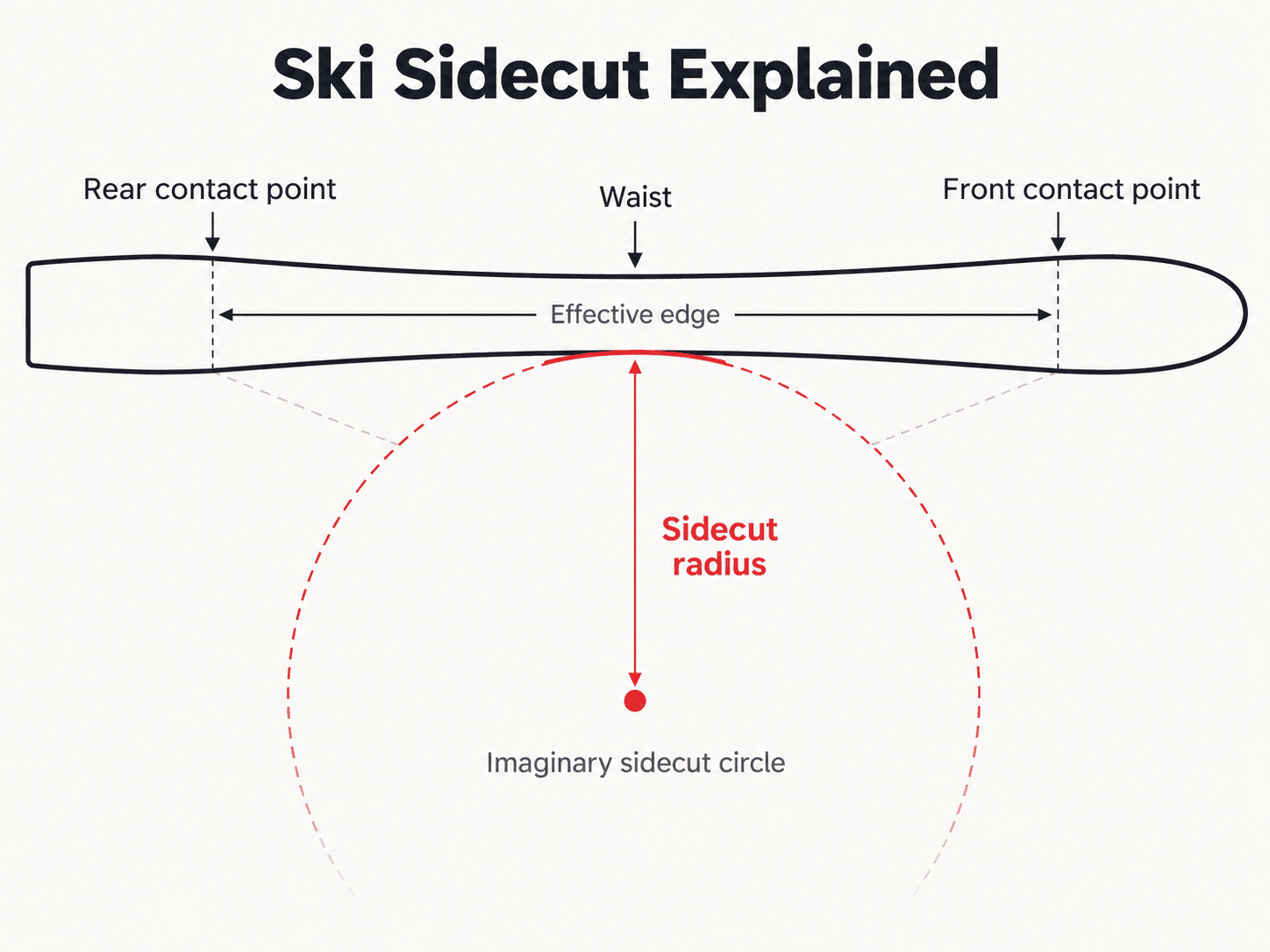
A ski with a deeper sidecut generally has a shorter radius, while a straighter ski has a longer one.
As a rough guide:
Short radius (around 10–14m): Naturally suited to tighter, quicker carved turns.
Medium radius (around 15–19m): A versatile middle ground for recreational skiing.
Long radius (20m+): Generally happier making wider, more drawn-out carved turns.
These aren’t strict categories, and you’ll find plenty of skis that fall outside them.
One thing worth clearing up: a 17m sidecut radius doesn’t mean every turn you make will have a 17m radius.
You can skid, steer and vary your edge angles to change your turn shape. The stated radius is a useful indication of how the ski is designed to carve, not a set of instructions.
Does Sidecut Really Matter?
Yes. Particularly when you’re carving on groomed snow.
A ski with a deeper sidecut generally wants to come around into a tighter arc when you tip it onto its edge. A straighter ski tends to favour longer, more gradual turns.
I’ve spent years teaching people to carve, and you can definitely feel the difference when moving between a short-radius piste ski and something designed for big, fast turns.
That said, sidecut is only one part of ski design.
Flex, width, rocker, length and construction all affect how a ski actually feels. Two skis with identical sidecut radii can behave very differently once you’re on snow.
And if you’re mostly skidding your turns rather than carving, the difference in sidecut radius becomes less obvious.
Which Sidecut Should You Choose?
I wouldn’t obsess over it.
If you love making tight carved turns on groomers, a shorter-radius ski is worth considering. If you prefer bigger, faster arcs, something with a longer radius might suit you better.
For most recreational skiers, a medium-radius all-mountain ski is a perfectly sensible place to start.
But I certainly wouldn’t choose a ski based on sidecut radius alone.
When I was fitting skis in shops, we’d occasionally get customers who’d researched every measurement imaginable before coming in. They’d know the exact waist width, radius and construction of six different skis.
Then we’d ask what sort of skiing they actually enjoyed, and they’d look slightly confused.
That’s still the more important question.
Ski length also affects how a ski handles, although a longer ski isn’t automatically harder to turn. If you’re unsure where to start, our ski size calculator can help you narrow down an appropriate length.
My Take
Sidecut is worth understanding, but it isn’t something I’d lose sleep over.
It’s one of the reasons a slalom ski feels completely different from a big-mountain freeride ski, even before you start considering width and flex.
Once you understand what those numbers mean, ski specifications become a lot more useful.
Just don’t become the person who spends three hours comparing 16m and 17m turn radii instead of actually going skiing.
I’ve probably been that person at some point.
See you out there!

