

Before visiting Hakuba, I’d heard that it wasn’t just one big ski resort, but a whole valley of different mountains. That was what excited me most about the trip. I could spend one day carving groomers, another exploring steep terrain, and the next hunting for powder through the trees, all without travelling too far.
Over the trip, I managed to ride seven resorts: Sanozaka, Goryu, Hakuba47, Happo-One, Iwatake, Tsugaike and Cortina. The variety was incredible, and each mountain had something different to offer.
Not everything went to plan. We had some pretty terrible weather, missed out on a few areas I’d been desperate to ride, and even got ourselves lost in the trees at one point. But I came away with a much better idea of which Hakuba resorts I’d return to, and which I’d recommend for different types of riding.
Here’s how the trip went.
Sanozaka: Carving With a View of Lake Aoki
My first day was at Sanozaka, a small resort south of Hakuba village, right beside Lake Aoki. It’s away from the busier central resorts and has a much quieter, more relaxed atmosphere.
Most of the terrain is made up of beginner and intermediate groomed runs, with a few patches of trees along the sides. I noticed that a lot of the snowboarders here were practising their carving, which makes sense given the wide, relatively gentle slopes.
What really surprised me was the scenery. I’d never ridden anywhere quite like it. Looking down towards Lake Aoki, with forest and mountains surrounding the water, was absolutely beautiful.
My favourite was the lake-view run, which is around 1,500 metres long with a maximum gradient of just 18 degrees. It’s wide and open, without any big rollers or unexpected drops, so you can relax into your turns while enjoying the view. It’s also the only run on the mountain that looks directly out over the lake.

Sanozaka also offers lift tickets based on the number of rides, rather than just full-day passes. That’s useful if you only want to spend a morning there before heading somewhere else.
It’s not a mountain I’d choose for challenging freeride terrain, but I really enjoyed starting the trip somewhere peaceful. If you like carving and aren’t bothered about riding the biggest resort in the valley, Sanozaka is worth considering.
Goryu and Hakuba47: Groomers, Trees and Terrain Parks
On the second day, I teamed up with a few snowboarders I’d just met and headed to Goryu and Hakuba47. The two resorts are connected, so you can ride both on the same lift pass, although they have quite different terrain.
Goryu
Goryu has some of the best long groomed runs in the area, and it’s a favourite among carving enthusiasts. It also offers night riding, which ran from 6 pm to 9:30 pm during my visit. The freshly groomed slopes were much quieter in the evening, making it a great time to practise turns without constantly watching out for other people.

The upper Alps-Daira area is particularly good for carving. Both the Panorama and Grand Prix runs are broad, with fairly consistent gradients, so you have plenty of space to make long turns.
About halfway down, I took a right into the Woody area, where the snow was much firmer. Without fresh snowfall, some sections become quite icy, and you need good edge control to ride them confidently.
Further down towards Toomi, the terrain changes again. There are sections of natural moguls, followed by Kamishiro, a narrow gully through the trees with steep pitches and tight gaps. It’s much more technical than the open groomers higher up, and I kept thinking how good it would be after a big snowfall.


For beginners, Iimori is one of the main areas to head for. The slopes are much more forgiving, with plenty of room to practise basic turns.
There are also little natural side hits and kickers scattered along the edges of many runs. I always enjoy finding these sorts of features, especially when you’re spending most of the day on groomers.
Hakuba47
Hakuba47 was a completely different experience. The resort has a strong freestyle scene, and the terrain park was full of skiers and snowboarders practising tricks.
One of my favourite things was simply watching everyone from the chairlift. You get a great view of the park as you ride up, with people hitting jumps and working their way through the different features.
There were jumps of different sizes, rails, boxes and halfpipe features, with smaller obstacles for riders who were still learning. You don’t have to be an experienced park rider to find something to try.

I really liked the contrast between these two resorts. You could spend the morning carving Goryu’s long groomers, then head over to Hakuba47 for a completely different style of riding.
One small tip: when I visited, you could return your lift ticket at the end of the day and get a 500-yen deposit back. Check whether this still applies when you go.
Happo-One: Steep Terrain and an Unexpected Hike
Happo-One is probably the most famous resort in the Hakuba Valley. It hosted events during the 1998 Nagano Winter Olympics and has the largest vertical drop of the resorts in the area.
I was really looking forward to riding it, but unfortunately we arrived on a day with strong winds and terrible visibility. The upper mountain is quite exposed, and I later learned that wind-related lift closures are fairly common when the weather turns bad.

Happo-One is well known for its natural mogul courses, particularly Kurobishi and Usagi-daira. We took one look at the conditions and decided not to attempt them.
Instead, we headed for Riesen Slalom, a run of roughly 2 km with steep sections reaching around 20–30 degrees. The snow was deep that day, and I had a fantastic time practising quick edge changes on the steeper pitches.
Unfortunately, we hadn’t studied the route properly.
We kept following the right-hand side of the run, assuming it would eventually bring us back towards the base. Instead, we drifted further into the trees and ended up at a dead end.
We should have stayed left, but by the time we realised our mistake, there was no easy way out. We ended up hiking all the way back up to the trail entrance.


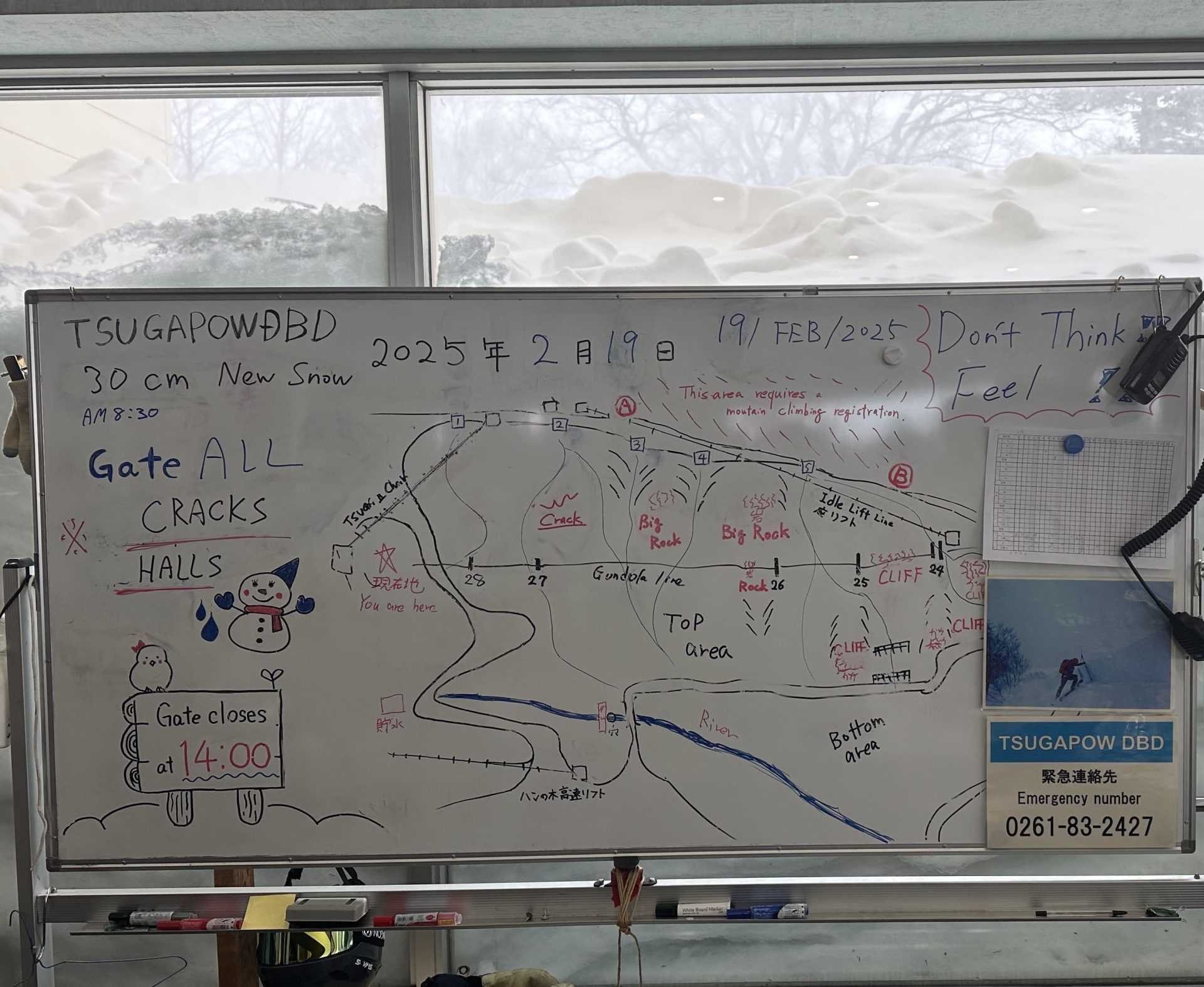
Although we couldn’t ride the official DBD zone, we did explore some lower terrain elsewhere on the mountain.
It was more complicated than I’d expected, with natural gullies and uneven sections through the trees. We followed existing tracks towards the groomed runs, although tracks aren’t always a reliable indication of a safe exit, particularly in unfamiliar terrain.
Near the bottom, we came across a tall, almost vertical embankment covered in icicles. We had to slow down and work our way around the side rather than trying to ride straight down it.

I left Tsugaike feeling like I’d barely scratched the surface. The mountain has some interesting terrain, but the weather prevented us from riding the area I’d most wanted to see.
It’s definitely somewhere I’d give another chance.
Cortina: My Favourite Resort for Powder
I spent the final two days of the trip at Cortina, and it ended up being my favourite resort in Hakuba.
Cortina sits at the northern end of the valley, connected to neighbouring Norikura. It’s known for receiving some of the heaviest snowfall in the area, which is why so many powder riders head there after a storm.
The terrain was exactly what I’d been hoping to find in Japan: deep snow, steep trees and natural features that made every run interesting.


We followed the route down towards the dam, crossed a narrow track and eventually emerged into the Norikura area. From there, we used Chair 6 to head back up.
I loved the combination of steep tree riding and natural terrain, but it’s important to remember that these routes aren’t ordinary groomed pistes. Access arrangements, snow conditions and hazards can change, so don’t rely on an old route description when planning where to ride. Check the current resort rules and avalanche information, and make sure you have the necessary equipment and experience.
For me, Cortina was the highlight of the trip. If I returned to Hakuba during a big snowfall, it would be one of the first places I’d consider.
The only downside is that plenty of other riders have the same idea. Lift queues can build quickly on powder days, so it’s worth arriving early.

Where to Stay in Hakuba
I stayed in two different places during the trip.
For the first two nights, I booked a Chinese-run guesthouse that cost around 7,000 yen per night. It felt a little expensive at the time, but breakfast was included, along with shuttle transport to some of the resorts.
For the rest of the trip, I moved to an Australian-run hostel. This was much cheaper, at around 1,200 yen per night, and I found it quiet, clean and excellent value.
The main drawback was the location. It was about a ten-minute walk from the bus stop, which became rather less enjoyable when I was carrying my snowboard and all my gear.
Those were the prices I paid during my trip, rather than current accommodation rates.


Once you’re in Hakuba, getting between the resorts is fairly manageable, but it’s worth planning your journeys in advance.
Many hotels and guesthouses offer shuttle services, although you’ll need to check which mountains they serve and when the buses run. There are also local buses, some free and others paid.
During peak season, these can get extremely crowded. On some journeys, we were standing the whole way while trying to hold onto our snowboards, which wasn’t particularly comfortable.

Taxis were also difficult to find at short notice. I wouldn’t recommend relying on being able to flag one down when you need it.
My advice would be to check the bus timetable the night before and leave yourself plenty of time, especially if you’re heading to one of the resorts further along the valley.
Shopping and Onsens in Hakuba
Hakuba village has quite a few outdoor shops, including Montbell and Patagonia. They’re nice to wander around if you have some spare time or fancy taking a break from snowboarding.
One of my favourite experiences away from the slopes, though, was visiting an onsen.
Some friends from the guesthouse recommended Tenjin-no-Yu, so we decided to check it out after riding.
The outdoor bath had an incredible view of the snow-covered Hakuba mountains. Sitting in the hot water with those peaks directly in front of me was such a good way to finish the day, especially after spending hours out in the cold.

If you’re visiting Japan for the first time, I’d definitely recommend trying an onsen while you’re there. It’s a lovely part of the experience, and particularly welcome after a long day on the mountain.
Which Hakuba Resort Did I Like Best?
After riding seven different resorts, I found it difficult to choose just one favourite because they offered such different experiences.
For carving, I really enjoyed Goryu. The long, wide groomers were excellent, and being able to ride into the evening was a bonus. Sanozaka was also lovely for a quieter day, especially with the views across Lake Aoki.
Hakuba47 stood out for its terrain park, while Happo-One had some of the most challenging groomed terrain I encountered. I’d have liked better weather there, as I feel there’s still a lot I haven’t explored.
Iwatake and Tsugaike are harder for me to judge fairly. I didn’t get to ride the areas I was most interested in, so I’d love to return when the snow and visibility are better.
But if I had to pick one resort from this trip, it would be Cortina.
I love riding powder through the trees, and Cortina had the terrain and snow I’d been hoping to find. Those final two days were easily among my favourite memories of Hakuba.
Would I Go Snowboarding in Hakuba Again?
Absolutely. What I loved most about Hakuba was being able to experience so many different mountains in one trip.
I could spend one day carving beside a lake, another riding steep slopes and moguls, then head further north for deep powder in the trees. Even the smaller resorts had something interesting about them.
If I went back, I’d probably keep my schedule more flexible and decide where to ride based on the weather and snow conditions. We lost some good opportunities because of strong winds and poor visibility, and I’d love another chance to explore the DBD area at Tsugaike and the natural terrain at Iwatake.
I’d also happily spend another couple of days at Cortina.
There are still plenty of places in Hakuba I haven’t explored, which is a good enough reason for me to return.
See you there?
