
I’ve become particularly adept at gaining weight during the off-season. Unfortunately, this year I’ve excelled myself.
I’m now comfortably over the recommended weight range for my beloved Bataleon Surfer. Which begs the question: do I need a new snowboard, or just a little more self-restraint at the dinner table?
Having spent years teaching snowboarding, I’ve also come across plenty of riders who are concerned about being too heavy for their board.
The good news is that snowboard weight ranges aren’t quite as restrictive as you might think. But there are some very good reasons not to ignore them entirely.
Here’s what actually happens when you’re too heavy for your snowboard.
Can You Exceed a Snowboard’s Weight Limit?
Absolutely. A snowboard’s recommended weight range isn’t necessarily a structural weight limit. Nothing particularly dramatic happens when you exceed it by a few pounds.
It’s essentially the manufacturer’s indication of the weight range within which the board is designed to perform as intended.
Take my 159cm Bataleon Surfer, for example. According to Bataleon’s size chart, I should weigh somewhere between 169 and 213lbs. Apparently, I’ve been a little too enthusiastic about the off-season.
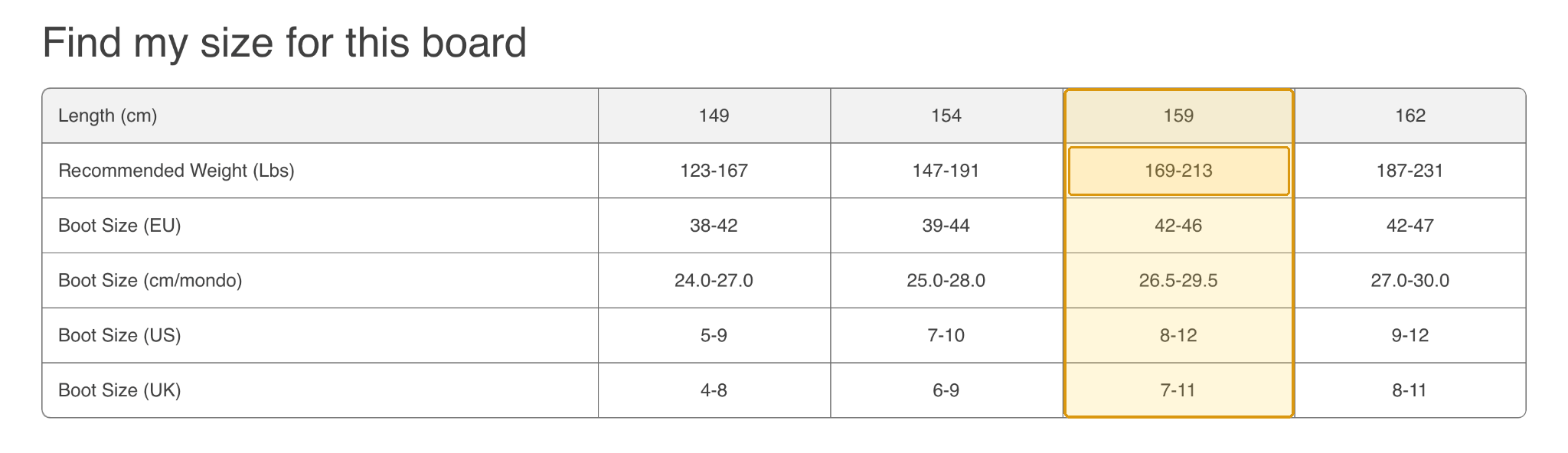
Even then, there’s an element of personal preference. An experienced rider might deliberately choose a smaller board for its manoeuvrability, whilst someone who enjoys riding at speed might prefer something with a little more length and stability.
I certainly wouldn’t be rushing to replace a snowboard because of a particularly indulgent Christmas.
What Happens If You’re Too Heavy for Your Snowboard?
The most noticeable difference is how the board flexes.
A snowboard that feels relatively stiff to a 150lb rider might feel considerably softer to someone weighing 220lbs. They’re riding exactly the same snowboard, but applying very different forces to it.
If you’re significantly over the recommended weight range, you might find:
- The board feels less stable at higher speeds.
- The nose or tail folds more easily under pressure.
- It’s harder to maintain a solid edge through aggressive carves.
- You sink more readily in powder.
On the flip side, the board might be easier to butter and more playful at lower speeds. Whether that’s a good thing depends entirely on how you like to ride.
Can You Break a Snowboard by Being Too Heavy?
Technically, yes. But simply exceeding the recommended weight range is unlikely to result in your snowboard spontaneously snapping in half.
Heavier riders can place greater stress on a snowboard, particularly when landing jumps or loading the nose and tail aggressively.
I’d be far more concerned about repeatedly landing tail-heavy on an undersized park board than being 10lbs over the recommended weight range whilst cruising around the resort.
Should Heavier Snowboarders Ride Longer Boards?
Generally speaking, yes. But length is only part of the equation.
One of my biggest frustrations as an instructor is seeing people choose snowboards based almost exclusively on their height. Your snowboard has no idea how tall you are, but it certainly knows how much you weigh.
A wider, stiffer 154cm snowboard might be considerably better suited to a heavier rider than a narrow, softer 160cm board.
Volume-shifted snowboards are a particularly good example of this. Their additional width allows you to ride a shorter board without sacrificing quite so much surface area.
If you’re unsure what length to ride, our snowboard size calculator takes your weight, amongst other factors, into account. Just make sure you cross-reference the result with the manufacturer’s weight range for the specific board you’re considering.
If you’re consistently above the weight ranges for the boards you’re considering, look for something with a little more substance rather than simply adding centimetres.
Am I Going to Replace My Snowboard?
No. Partly because I love my Bataleon Surfer and partly because admitting defeat to a snowboard would be a new low for me.
I know the board well, I’m comfortable riding it and I’m yet to find my additional insulation particularly detrimental to its performance.
If you’re in a similar position and still enjoying your snowboard, there’s probably no need to replace it.
If, however, you’re finding that your board regularly folds under pressure, feels unstable or struggles to keep you afloat in powder, it might be time to reconsider your sizing.
As for me, I suspect a slightly smaller dinner plate would be considerably cheaper than a new snowboard.

