
Snowboards come in all sorts of shapes these days. Some are perfectly symmetrical, while others have long noses, narrow tails or look more like surfboards than anything you’d expect to see on a mountain.
I’ve ridden everything from traditional twins to some pretty ridiculous-looking powder boards. And while the differences can be huge, it’s not always obvious what you’re actually gaining (or giving up) with each design.
So let’s look at the main snowboard shapes, what they’re good at, and which one might suit your riding. We’ll also get into the different nose and tail shapes, because there’s more to them than you might think.
The Six Main Snowboard Shapes
Most snowboards fall into one of six broad categories:
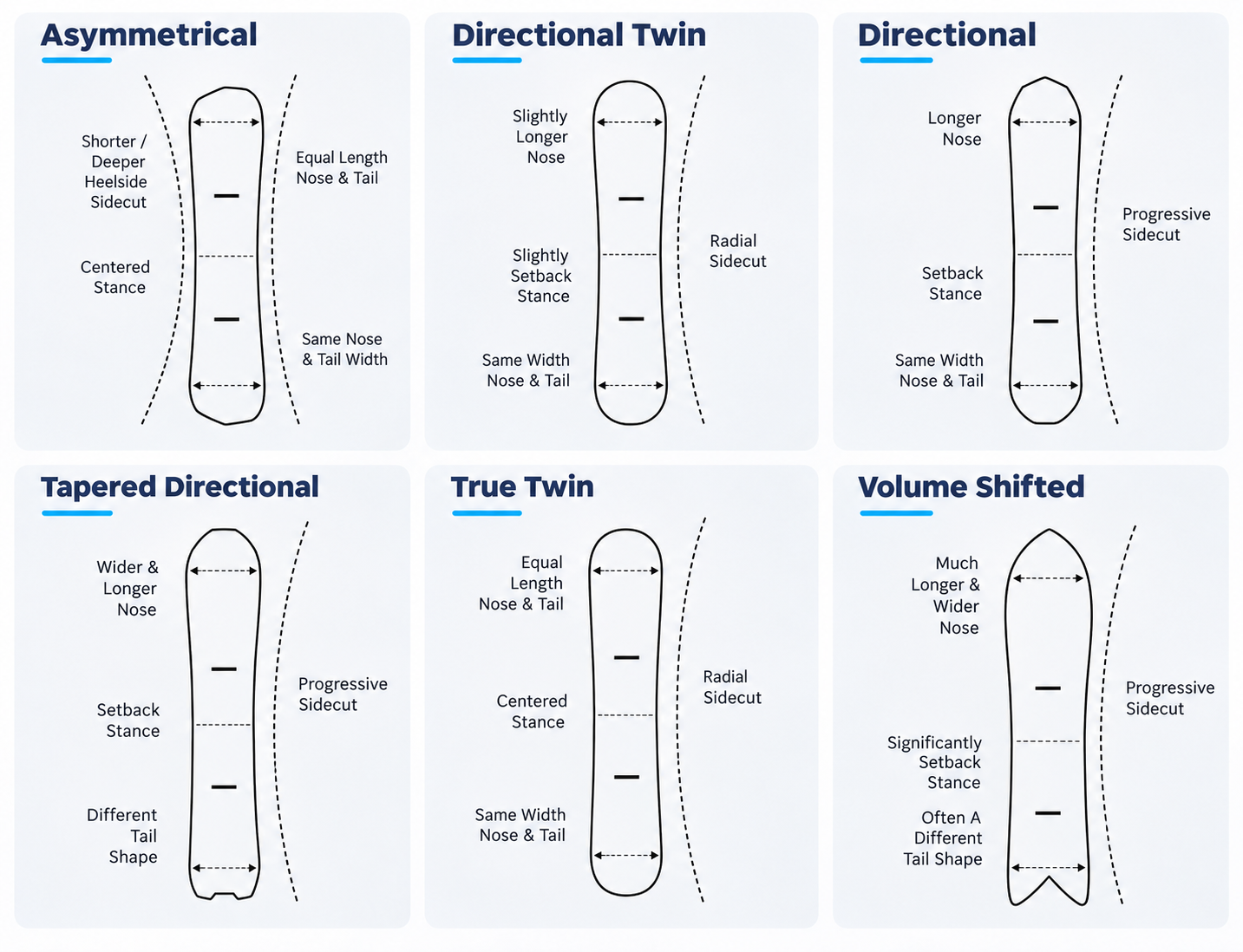
Some of these shapes look almost identical at first glance. Others are pretty hard to mistake for anything else!
The important thing is how they’re designed to ride. A true twin is built to feel the same in either direction, while a directional board generally favours riding forwards. Tapered shapes tend to offer better float in powder, and volume-shifted boards squeeze a lot of surface area into a shorter length.
These categories aren’t completely separate, either. A snowboard can be directional, tapered and volume-shifted. Think of them as useful ways of describing a board’s design rather than six rigid rules.
Let’s go through them individually.
True Twin Snowboards
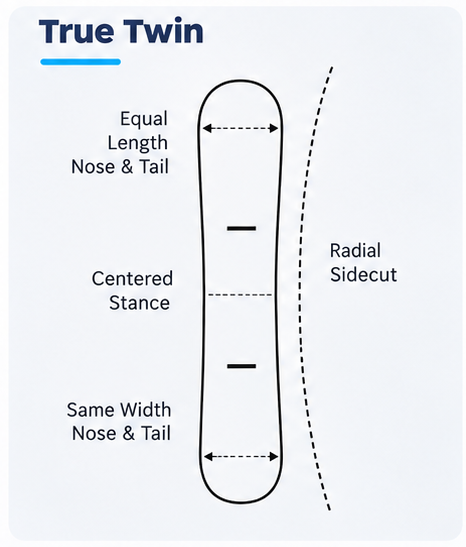
A true twin is exactly what it sounds like… a snowboard that’s identical at both ends.
The nose and tail have the same shape, the stance is centred, and the flex and sidecut are symmetrical.
The big advantage? It rides the same whether you’re going forwards or switch.
That’s why true twins are so popular with freestyle riders. Whether you’re hitting jumps, riding rails or spinning off side hits, you don’t have to think about which end of the board is leading.
But they’re not just for park rats. A good true twin can be brilliant for everyday resort riding, especially if you enjoy messing around on the mountain rather than charging in one direction all day.
The trade-off is that you don’t get some of the advantages of a more directional design, particularly when it comes to floating in deep powder. You can absolutely ride a twin in powder, but you’ll generally have to work a bit harder to keep the nose up.
Directional Twin Snowboards
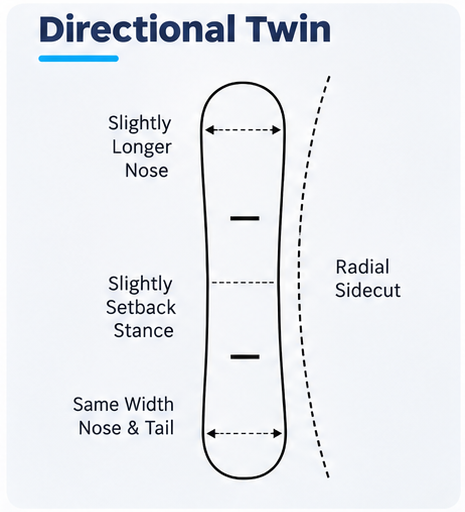
A directional twin is essentially a true twin with a few subtle changes to favour riding in your normal direction.
Unlike a true twin, where the nose and tail are identical, a directional twin might have a slightly longer nose, a setback stance or a different flex pattern between the two ends.
The sidecut is usually symmetrical, so it still feels relatively balanced when riding switch.
It’s one of my favourite shapes for all-mountain snowboarding.
You retain much of the playful, predictable feel of a twin, but those small design changes can give you a little extra float in powder or support when riding more aggressively.
And importantly, you can still ride switch perfectly well. It just might not feel quite as identical in both directions as a true twin.
For riders who spend most of their time exploring the mountain, hitting side hits and occasionally venturing into the park, a directional twin is a pretty compelling compromise.
Directional Snowboards
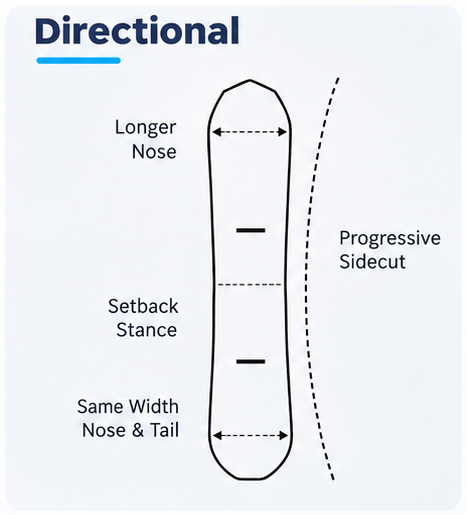
Directional snowboards are designed primarily to be ridden in one direction, with a distinct nose and tail rather than the balanced shape of a twin.
The difference from a directional twin goes beyond simply having a longer nose. Directional boards often have a more pronounced setback stance, different nose and tail shapes, and a sidecut or flex pattern designed specifically for riding forwards. The whole board is built around that direction of travel, rather than trying to feel equally comfortable both ways.
That doesn’t mean they’re all stiff, aggressive freeride machines. Directional boards range from mellow all-mountain cruisers to powerful carving boards, and their personalities can be wildly different.
Personally, I love a good directional board for carving. There’s something satisfying about driving through a turn with a supportive tail behind you, particularly when you’re picking up speed. And if you spend most of your time riding forwards anyway, there’s not much reason to insist on a perfectly symmetrical board.
You can still ride switch on most directional snowboards, although the difference between nose and tail usually makes it feel less natural than on a twin.
Tapered Directional Snowboards
A tapered directional snowboard takes the directional concept a step further. The defining feature is taper – the tail is narrower than the nose.
That might sound like a small detail, but it changes how the board behaves, particularly in powder.
The wider nose provides more surface area up front, while the narrower tail tends to sink more easily into soft snow. This helps keep the nose floating without you having to lean back quite so much.
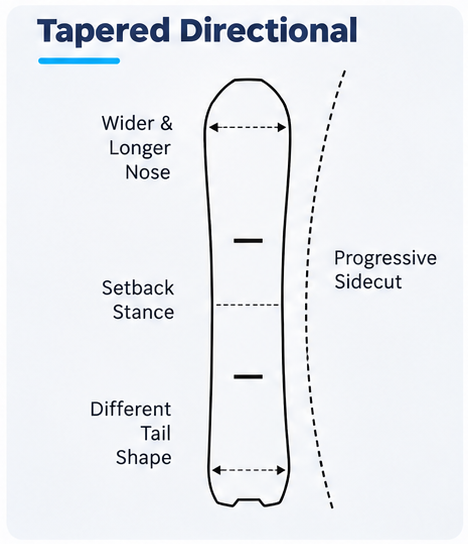
You’ll find taper on everything from fairly conventional freeride boards to some wonderfully weird powder shapes, including boards with swallowtails and fishtails. Not all tapered boards have dramatic outlines, though. Some look surprisingly normal until you compare the width at either end.
I’ve always enjoyed the surfy feel of a tapered board in deep snow. They can make slashing through powder and weaving between trees feel effortless, although the exact experience depends heavily on the board’s width, flex and rocker profile.
The trade-off is versatility. A heavily tapered powder board isn’t usually something you’d choose for riding switch or spending the afternoon in the park. But a moderately tapered directional board can still be a fantastic everyday freeride option.
Volume-Shifted Snowboards
Volume-shifted snowboards are the short, wide oddballs of the snowboard world. And they’re a lot more fun than their slightly strange proportions might suggest.
The idea is simple… instead of getting the surface area you need from a longer board, you get more of it from the width. This means you can ride a shorter snowboard without sacrificing as much float in powder.
Some volume-shifted boards are designed to be ridden 5–10 cm shorter than your usual length, although the amount varies considerably between models.
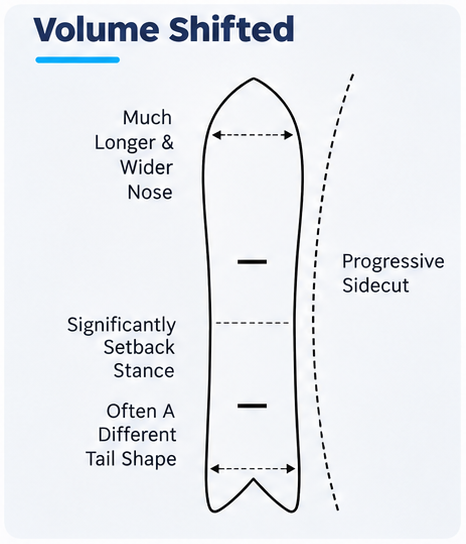
The shorter length can make them wonderfully nimble, especially when weaving through trees or making quick turns in tight spaces.
I’ve ridden a few of these over the years, and there’s something addictive about having a board that feels so compact underfoot but still floats beautifully in deep snow. The extra width can also provide excellent support when carving, although it may make edge changes feel slower if the board is particularly wide for your boot size.
One important distinction: volume-shifted isn’t technically a separate snowboard shape in the same way as true twin or directional. It’s more of a design approach. A volume-shifted board can also be directional, tapered or even a twin.
And they’re not all powder specialists. Some are surprisingly capable on groomers, while others are very much built for those glorious days when the snow is waist-deep.
Asymmetrical Twin Snowboards
An asymmetrical twin looks much like a regular true twin, but there’s a clever difference… the heel and toe edges aren’t designed quite the same way.
Most asymmetrical twins have a tighter sidecut on the heel edge, although some also use different flex patterns or contact points.
The idea is to compensate for the fact that our ankles, knees and hips don’t move quite as naturally through a heel-side turn as they do on our toes.
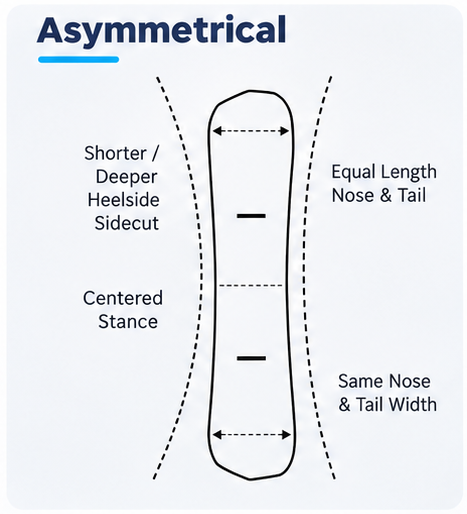
In practice, this can make heel-side turns feel smoother and easier to initiate, particularly when carving. It’s not some magical fix for poor technique, but a well-designed asymmetrical board can make the two edges feel more balanced.
Otherwise, they’re much like regular twins. You can ride switch, hit jumps, lap the park and generally mess around across the mountain. The asymmetry is designed around your heel and toe edges, not which end of the board is pointing downhill.
There’s one catch worth knowing: asymmetrical twins need to be set up for your stance. Depending on the design, that means choosing the appropriate stance orientation or mounting the bindings correctly so the heel-side geometry ends up beneath your heels.
They’re still relatively uncommon compared with conventional twins, but they’re an interesting option if you enjoy freestyle riding and want a slightly different feel through your turns.
Snowboard Nose Shapes
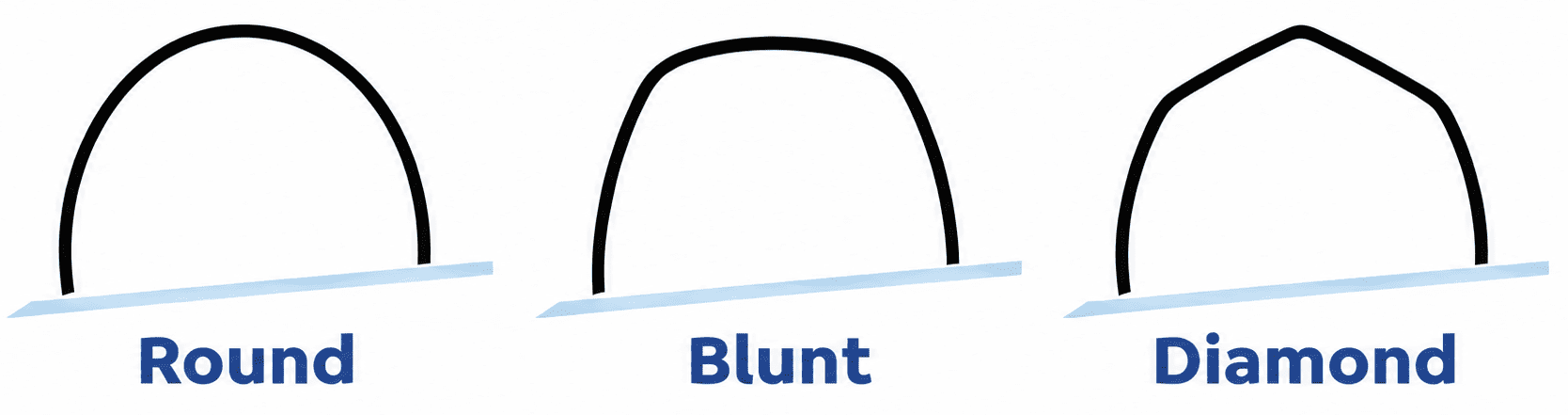
The nose (or tip) is the front end of your snowboard, and its shape can influence everything from powder float to how much unnecessary length you’re carrying around.
Most snowboard noses fall into three broad styles: round, blunt and diamond. You’ll find plenty of variations, particularly on powder boards, but these cover the most common designs.
1. Round Nose
The classic snowboard nose. Rounded tips have been around since the early days of snowboarding, and they’re still found on everything from freestyle twins to all-mountain boards.
The curved outline provides a straightforward, versatile design without favouring any particular riding style. On a true twin, you’ll usually find the same rounded shape at both ends.

There’s nothing especially fancy about it, but that’s part of the appeal. It’s a proven design that works across just about every type of terrain.
2. Blunt Nose
A blunt nose has a flatter, more squared-off tip, rather than the traditional rounded outline.
By trimming away some of the material beyond the contact points, manufacturers can reduce the board’s overall length and potentially save a little swing weight without significantly changing its effective edge.

That’s particularly useful on freestyle boards, where a compact shape can make spins and other tricks feel more manageable.
You’ll also find blunt noses on plenty of all-mountain and freeride boards.
Just don’t confuse a blunt nose with a board that’s necessarily easier to turn. The sidecut, flex and overall geometry have a much bigger influence on that.
3. Diamond Nose
Diamond noses have a more angular outline, with the sides meeting at a pointed or slightly flattened tip.
They’re particularly common on directional and powder-focused snowboards, where they often form part of a longer, wider nose designed to provide extra float.

They certainly look the part, especially on surf-inspired shapes. But the pointed tip itself isn’t some secret weapon for slicing through crud or powder. It’s the overall nose width, length, rocker and surface area that make the bigger difference.
In other words, a diamond nose can be part of an excellent powder design, but the shape of the very tip isn’t what makes it float.
Snowboard Tail Shapes
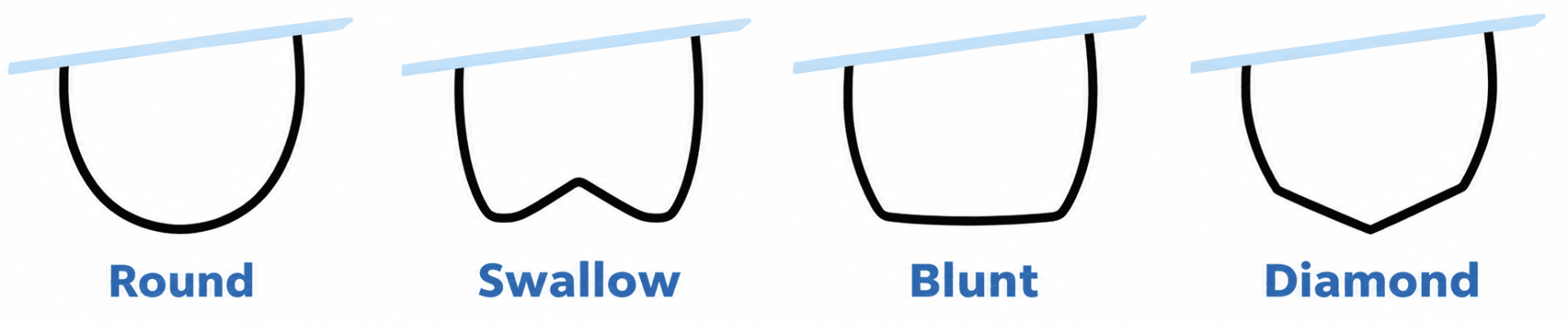
Snowboard tails come in many of the same shapes as noses, including round, blunt and diamond designs. The principles are much the same, so there’s no need to go through them all again.
The interesting exception is the swallowtail, which you’ll mostly find on powder-focused snowboards.
Swallowtail Snowboards
Swallowtails are pretty hard to miss. Instead of a conventional rounded tail, they have a distinctive V-shaped cutout, giving the back of the board its familiar split appearance.
And unlike some of the more cosmetic nose and tail variations, this design can make a noticeable difference in deep snow.

The cutout reduces the surface area at the tail, helping it sink into powder while the nose stays up. Combined with a setback stance and a wider nose, this can give the board that lovely, surfy feeling where you’re steering through the snow rather than fighting to keep the front afloat.
I’ve always had a soft spot for these shapes. They’re brilliant fun in deep powder, particularly when making big, sweeping turns.
Of course, there’s a trade-off. A deeply cut swallowtail generally offers less tail area for switch riding, landings and freestyle tricks. But if you’re buying one, chances are those aren’t your priorities anyway.
Which Snowboard Shape Should You Choose?
There’s no single snowboard shape that’s best for everyone. It really comes down to where you ride, what you enjoy doing and how much versatility you need.
Here’s where I’d start:
Freestyle and park: A true twin is the obvious choice if you’re regularly riding switch, hitting jumps or spending time on rails. Asymmetrical twins are another good option, particularly if you like carving between park laps.
All-mountain: Directional twins are hard to beat for versatility. They’re playful enough for side hits and switch riding, but offer a few advantages when you’re exploring the rest of the mountain. A less aggressive directional board can work just as well.
Carving: I’d lean towards a directional board with a supportive tail and a sidecut suited to carving. Some tapered and volume-shifted designs are excellent carvers too, although shape alone doesn’t determine edge hold.
Freeride: Directional and tapered directional boards are generally the way to go. They’re designed with riding forwards in mind and often provide better support and float in variable terrain.
Powder: Tapered directional and volume-shifted boards are great starting points, especially if you enjoy surfy turns and weaving through trees. Longer directional powder boards can be equally brilliant, particularly in open terrain.
If you’re buying your only snowboard, I’d generally favour versatility over something highly specialised. A good directional twin or all-mountain directional board will cover an enormous amount of riding without feeling out of place when conditions change.
On the other hand, if you’ve already got an everyday board, that’s when experimenting with something a bit weird and wonderful becomes much more appealing.
Does Snowboard Shape Affect Sizing?
Absolutely. Two snowboards with the same length can ride very differently depending on their width, effective edge and overall shape.
Volume-shifted boards are the obvious example. Their extra width means you can often ride them considerably shorter than a traditional snowboard without losing too much float. But don’t assume every directional or powder board needs sizing down. Some are designed to be ridden at your usual length, or even longer.
If you’re unsure where to start, try our Snowboard Size Calculator. For a deeper explanation, we’ve also covered how snowboard shape affects sizing in a separate guide.
What's the Best Snowboard Shape for Beginners?
For most beginners, a true twin or directional twin is a great place to start. Both are versatile, easy to get along with and give you plenty of room to experiment as your riding progresses.
Directional twins are particularly good if you’re mainly interested in exploring the mountain, while true twins make sense if you’re keen to learn switch riding and freestyle tricks.
But here’s the thing… shape alone doesn’t determine how beginner-friendly a snowboard is.
A stiff, aggressive true twin can be far more demanding than a mellow directional board. Flex, camber profile and sizing all play a big part in how forgiving a snowboard feels, particularly when you’re still learning to link turns.
I’d generally look for something with a softer to medium flex and a predictable, forgiving ride rather than getting too hung up on the outline. There’s plenty of time to experiment with more specialised shapes once you’ve worked out what kind of snowboarding you enjoy.
Final Thoughts
There’s a lot more to snowboard shape than whether the nose is pointy or round. Even small differences in width, taper and stance can change how a board feels under your feet.
But don’t get too caught up in finding the perfect shape. Some of my favourite boards have been ones I wouldn’t necessarily have picked based on their specs alone.
If you’re buying your first or only snowboard, versatility is usually a sensible place to start. And if you’ve already got a board you love? Trying something completely different can be half the fun.
Just be warned. That’s usually how a one-board quiver turns into five.

