
Moguls aren’t (entirely) random. They’re not something the mountain forgets to groom. And they’re not exclusively caused by skiers, much as I’d like to blame you f*ckers.
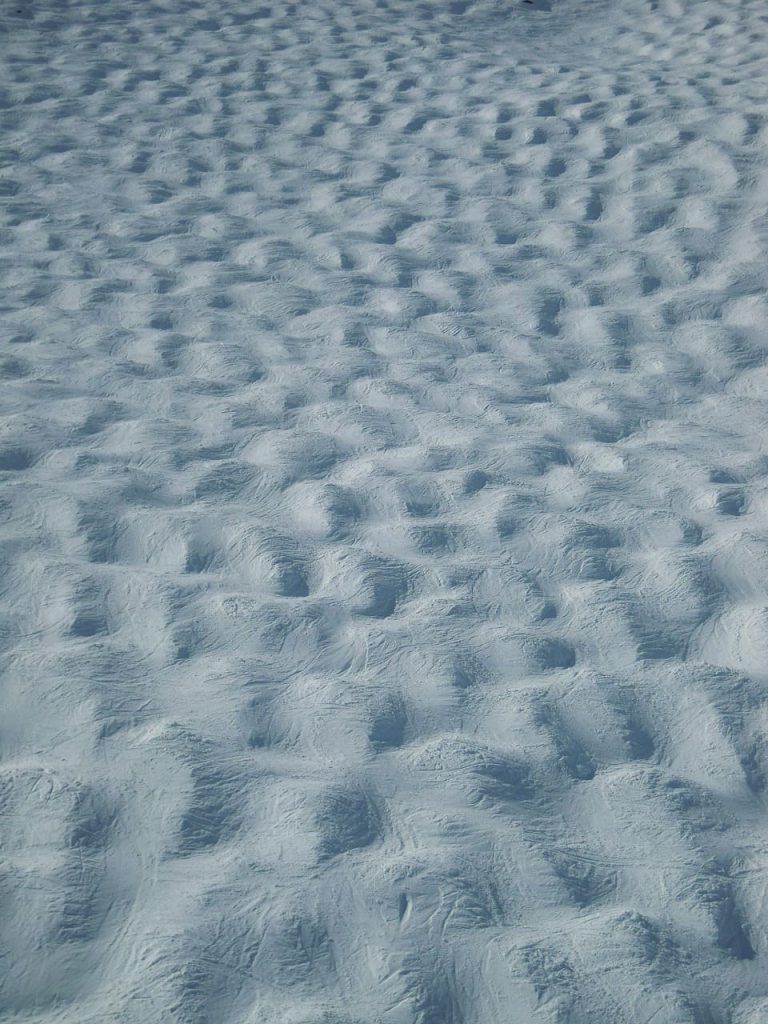
They form because of how skis interact with snow, gravity and each other. Once you understand that, bumps start to make a lot more sense.
People turning in the same spots
Most skiers turn in very predictable places. Usually across the fall line, usually where the slope feels steepest and usually where they feel the need to slow down.
Every turn scrapes a little snow downhill. Not much. But over hundreds or thousands of turns, that snow has to go somewhere.
Where people finish their turns, snow piles up.
Where people start their turns, snow gets scraped away.
Do that all day and you get bumps.
Snow moves downhill
Skis and snowboards don’t just glide over snow. They push it around.
Every edge set shoves snow slightly downhill and outward. Gravity does the rest. Over time, small piles become noticeable bumps.
Once a bump starts forming, people instinctively turn around it instead of over it. That just feeds the process. The bump grows faster because now everyone is helping.
This is why moguls tend to lock into place instead of spreading evenly across the run.
Troughs form where snow disappears
Between the bumps are troughs. These are the spots where snow has been scraped away again and again.
That’s why troughs often feel icy or firm, even when the bumps are still soft. Fresh snow gets pushed off quickly, exposing whatever was underneath.
That contrast between soft piles and hard channels is what gives mogul runs their special kind of misery.
Steeper runs bump up faster
Moguls form quicker on steeper terrain. Gravity moves snow more efficiently and skiers tend to make stronger, more abrupt turns to stay in control.
Flatter runs can bump up too, but it takes longer and usually requires a lot of traffic. Steep, popular runs are basically bump factories.
Why the bumps line up so neatly
Moguls often form in rows because skiers follow each other’s lines. Once a pattern starts, people copy it without realising.
Nobody thinks, I’ll ski exactly where that person just went. It just feels natural. The snow guides you.
That’s why mogul fields often look organised, even though nobody planned them.
Grooming just resets the clock
When a run gets groomed, the bumps disappear, but the slope underneath hasn’t changed. The terrain still encourages the same turn shapes in the same places.
As soon as traffic returns, the same forces are at work again. That’s why certain runs bump up in the same spots day after day, no matter how often they get flattened.
Why fresh snow doesn’t stop moguls
People assume powder prevents bumps. It doesn’t. It just slows things down.
Soft snow still gets pushed downhill. It just takes longer for piles to become obvious. On busy runs, moguls can come back surprisingly fast, even after a decent snowfall.
Why this matters
Understanding how moguls form makes them less annoying. They’re not there to punish you and they’re not a sign that you’re bad at skiing or snowboarding.
They’re just a record of how that run gets skied.
Once you start seeing them that way, they become easier to read (even if you still don’t enjoy skiing them).

