
I used to feel better when I saw tracks.
You hike a bit. You get to the top of something that looks untouched. Clean. Quiet. Then you spot it. One line already in there.
And there’s this tiny shift in your head.
Not relief exactly. More like permission.
Someone else thought it was fine.
That logic barely holds up though. One rider getting down a slope tells you almost nothing about what’s going on underneath. But in the moment it feels like information. It feels like evidence.
This winter in the Alps has been rough. Weak layers stacked on weak layers. Close calls. Too many fatalities. Tahoe has had awful news too. I’m not suggesting anyone followed tracks or didn’t. That’s not the point.
The point is how quickly our brains latch onto something that looks like reassurance.
I’ve watched it happen from both sides. Teaching. Touring. Standing at the top of lines with people who are better riders than me and still just as human.
That one set of tracks changes the conversation. Should it?
What That First Line Actually Tells You
Nothing.
That sounds blunt, but it’s true.
One rider getting down a slope without triggering anything does not mean the slope is stable. It means that under that exact load, in that exact spot, at that exact moment, nothing released.
That’s it.
It doesn’t tell you how close it was to failing. It doesn’t tell you whether they rode over the thickest part of the slab while a thinner section sits ten metres to the side. It doesn’t tell you whether the weak layer is continuous across the whole face or patchy and unpredictable.
Snowpacks aren’t uniform, especially not in seasons like this one. In the Alps this winter we’ve seen weak layers linger far longer than people expected. Some slopes have felt bomber. Others on the same aspect, same elevation, same day have produced collapses or worse.
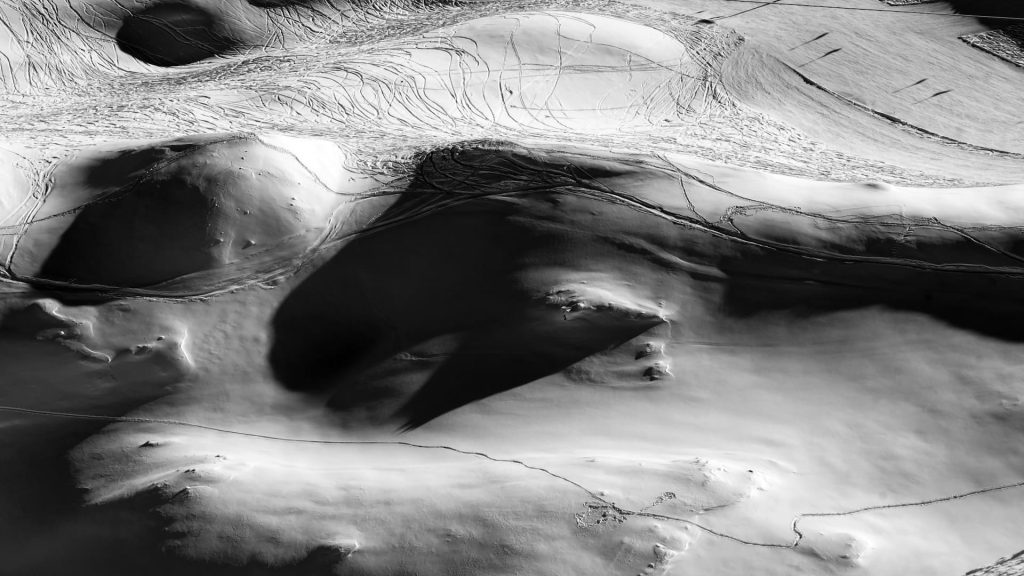
A single clean descent can hide a lot.
Sometimes the first rider simply hits the stronger part of the slope. Sometimes the slab is strong enough to support one person but not the cumulative load of several. Sometimes the trigger point isn’t where the most obvious line is.
I’ve been on days where nothing moved on the first run. Or the second. And then someone cuts slightly lower, or slightly wider, and suddenly you’re looking at a fracture line you didn’t expect.
Tracks don’t reset the snowpack. They don’t stabilise a weak layer. They don’t reduce consequence below.
They just show that someone went first.
And in a difficult season, where both the Alps and places like Tahoe have seen devastating accidents, that distinction matters. Not because any specific incident was caused by following tracks. But because this year has reminded a lot of us how unforgiving variability can be.
Fresh lines look like reassurance.
They aren’t.
How the Tone Changes
I spend a lot of timing thinking about human factors in decision making. Group dynamic is a massively under appreciated risk. When a group sees evidence of another group having been there, it’s proven to encourage riskier decisions.
It’s called “social facilitation”.
Seeing an existing line is the first stage.
The shift is rarely dramatic.
No one suddenly declares the slope safe.
But maybe someone says, “They just rode it.”
Another person nods.
Questions get shorter. Objections soften. The discussion about aspect and elevation loses a bit of its edge.
It’s not that anyone is being reckless. It’s that the uncertainty feels smaller. The unknown feels partially answered.
I’ve seen very experienced riders do this. Heck, I’ve done it myself. You stand there with all the right knowledge in your head and then you see a clean line already drawn down the face.
It changes nothing.
But the more desirable the line, the stronger that pull becomes. Fresh snow adds urgency. You’ve hiked. You’ve waited. You’ve watched other people drop into neighbouring faces. There’s a sense that this window is now.
That pressure doesn’t disappear just because you’ve taken a course or read the bulletin.
Why This Season Makes That Instinct Riskier
In a stable, straightforward snowpack, variability still exists. But this winter hasn’t been straightforward.
Across large parts of the Alps we’ve seen persistent weak layers sitting under slabs that look and feel supportive. Slopes that ski beautifully until they don’t. Terrain that holds for days and then surprises someone on what looks like a similar pitch nearby.
Tahoe has of course had devastating news as well. The people involved were highly experienced backcountry skiers. I’m not drawing any link between that tragedy and the idea of following tracks. None of us outside those mountains know exactly how those events unfolded.
I’m writing this with other skiers and riders in mind.
I hear amateurs say it all the time: “it has tracks in it.” As if that alone settles the question. A student even said it to me confidently the other day in 5/5 avalanche conditions.
The common thread in seasons like this isn’t recklessness. It’s uncertainty. One rider can cross a slope without consequence while another, slightly offset, hits the thinner part of the slab.
When variability is high, small differences matter more.
And following tracks encourages you to assume those small differences don’t matter.
Where Tracks Mislead You
There are a few ways this plays out in real terrain.
The first rider takes the most obvious line. Maybe that line happens to run over the thickest, strongest part of the slab. Ten metres skier’s right, the slab is thinner and more reactive. The second rider drifts slightly and finds it.
Or the first rider descends cautiously, keeping speed controlled and spacing good. The next two drop closer together, increasing load on the same weak layer.
Or the first descent occurs before the sun has had time to warm the slope. Conditions change subtly. The surface stiffens or softens. Stress redistributes.
Sometimes nothing happens at all. Sometimes something does. The point is that the presence of tracks does not remove that uncertainty.
One person getting away with a dangerous act should not prompt you to try the same.
What I Do Now
I still feel that mental shift when I see tracks. That hasn’t gone away.
The difference now is I try to separate the emotional relief from the actual information.
I ask myself what those tracks have truly added.
Have they changed the aspect? No.
Have they changed the known problem in the bulletin? No.
Have they reduced the consequence below? No.
All they’ve done is show that someone accepted the risk before me.
If I was uncomfortable before I saw them, I try to stay uncomfortable.
Sometimes that means choosing a different line. Sometimes it means spacing out more deliberately. Sometimes it means turning around even though the slope looks good and someone else is already halfway down it.
It’s rarely an easy decision. It always feels slightly awkward.
But I’d rather feel awkward than unsafe.
The Hard Bit
Fresh tracks look like reassurance.
They photograph well. They make a slope feel tested. They help settle the part of your brain that doesn’t like uncertainty.
But they don’t stabilise a weak layer. They don’t remove terrain traps. They don’t change how snow propagates across a face.
They just prove that one person went first.
Standing at the top of a line this winter, in a season that has reminded a lot of us how thin the margin can be, that distinction matters more than it used to.
So… stay home this week. Whilst avalanche ratings are 4-5/5, it’s simply not worth it. And spotting fresh tracks in the distance changes nothing.
Stay safe Amigo.

