
Regular readers know how much my knees suck. Or at least how much I whinge about them. I blew my ACL years ago and thought I’d never ride the same again. Turns out, with the right brace and a bit of humility, you can still charge pretty hard.
I’ve tried a lot of knee braces since then, both through rehab and back on snow. Some slip around the first time you ride, others dig trenches into your calf and a few are so bulky I just stopped wearing them.
These are the knee braces I’d actually use for skiing and snowboarding, whether you need proper support, some compression or protection from knocks.
🏆 Quick Pick
I’d start with the NEENCA Professional Hinged Knee Brace. I’ve used this one for years and put hundreds of hours on it in the mountains. It gives more support than a basic sleeve without feeling massively bulky. Once the straps are set properly it stays put. The Fit Geno below is cheaper and pretty similar, but I’ve spent far more time riding in the NEENCA.
How I Test Knee Braces
I’ve had dodgy knees for most of my riding career. The big one was an ACL reconstruction, followed by a lot of rehab and a fairly cautious return to snow. Since then I’ve used everything from basic compression sleeves to proper hinged braces, both skiing and snowboarding.
What matters on snow is slightly different to wearing a brace around the gym. It needs to stay put when you’re constantly flexing your knees, fit comfortably under ski or snowboard pants, and give you some support without making your leg feel like it’s strapped into a medieval torture device.

When I’m properly testing a brace, I’ll use it for at least a week before writing the review. That gives me enough time to get the fit dialed in and find the annoying little problems that don’t always show up on the first day.
I pay particular attention to whether a brace slips or rotates, how bulky it feels, whether the hinges or straps dig in, and whether I actually still want to be wearing it after a full day on the mountain.
Knee Brace, Compression Sleeve or Knee Pad?
These all do slightly different jobs, so the best option depends on what you actually want from it.
A hinged knee brace gives you the most substantial support of the three. The hinges sit either side of the knee and make the whole thing feel much more planted than a simple sleeve. They’re bulkier, but this is what I prefer when I want proper support rather than just compression.
A compression sleeve is the lighter option. You lose the rigid side support, but they’re much less noticeable under ski or snowboard pants. I like them when I want a bit of compression and support without feeling like I’ve strapped half a robot to my leg.
A knee pad is different again. Its main job is protecting your knee from direct knocks rather than stabilising the joint. That makes them particularly useful for skiing and snowboarding, where smashing a knee into hardpack is an occupational hazard. Some of the beefier pads also give you a decent amount of compression, but I wouldn’t treat one as a replacement for a hinged brace if support is what you need.
Best Knee Braces for Skiing & Snowboarding
I’ve used these through rehab and on snow, where I’m mainly looking for movement, pinching, heat and bulk under snow pants. A good brace should stay where you put it, give you the support you’re looking for and (ideally) be something you forget about once you start riding.
1. NEENCA Professional Hinged Knee Brace Best Overall

The NEENCA has been on this list for years, and I’ve spent hundreds of hours riding in it.
The X-strap setup is probably my favorite part. You can get the brace properly snug around the knee without simply cranking everything tighter and tighter, and once I had it dialed in it stayed in position remarkably well under my snow pants. That matters because a supportive brace is pretty useless if it gradually works its way down your leg every few runs.
You’ve also got proper hinged stabilizers running down either side. I found the lateral support noticeably stronger than the sleeves and lighter braces I tested, particularly when riding chopped-up snow or landing harder than intended. Despite that, I could still flex my knee normally enough that it never felt like I was riding around with my leg in a splint.


There are compromises. It’s considerably bulkier than a compression sleeve and you need to spend a little time getting the hinges lined up properly. Get that wrong and you can end up with an annoying pressure point. It can get pretty warm under tighter pants too.
The Fit Geno below is cheaper and uses a very similar hinged design, so it’s worth looking at if you want to spend less. But I’ve got far more time on snow with the NEENCA, and it’s still the one I’d put at the top of this list.
Pros
- Strong lateral stability from the hinged design
- X-strap system is easy to adjust
- Stays in position well under snow pants
- Good support on rough snow and harder landings
- Still allows plenty of movement while riding
- I've personally used this extensively on snow
Cons
- More expensive than the Fit Geno
- Bulky compared with a compression sleeve
- Needs careful hinge alignment to avoid pressure points
- Can get warm under tighter snow pants
2. Demon Hyper X V7 D3O Knee Pads Best Knee Protection

- Triple-layer D3O T6 impact protection
- Armortex/Kevlar front shield for abrasion resistance
- A.I. air-pad system for extra impact absorption
- Low-profile design fits under snow pants
- Lock-in Velcro straps keep the pads secure
I freaking love these things. The only reason the Demon Hyper X V7 isn’t sitting at number one is that it’s technically a knee pad rather than a knee brace.
What I really like is that you get more than just impact protection. They fit tightly enough around the knee that there’s a noticeable compression and stability element too. It’s not the same mechanical support you get from a hinged brace, but if you don’t actually need hinges, I much prefer riding in something like this.
These also pack some hefty protection.

The V7 uses D3O T6 padding with an “Armortex/Kevlar” front shield and Demon’s additional A.I. padding system. Lots of jargon – but in practice there’s basically a serious amount of material between your knee and whatever you manage to smash it into. For snowboarders especially, where dropping onto a knee on hardpack or ice is pretty common, that makes a lot of sense.
Despite all that padding, they still move surprisingly well. The straps hold everything firmly around the knee and they feel much more like part of your leg than some of the cheap, bulky knee pads I’ve used over the years.


They’re expensive for knee pads, but this is one of those products where I think the extra money is justified. If you specifically need the lateral stability of a hinged brace, buy a brace. For everyone else, these are probably my favorite option in the entire article. Highly, highly recommended.
Pros
- Excellent impact protection
- Noticeable compression and stability around the knee
- D3O T6 padding with a tough Armortex/Kevlar front shield
- Stays firmly in place while riding
- Moves surprisingly well for this much protection
- 25% off with code SNOWCHASERS
Cons
- Expensive for a knee pad
- Bulkier than a simple compression sleeve
- Doesn't replace a hinged brace if you need proper lateral support
3. The Fit Geno Hinged Knee Brace Best Value Brace
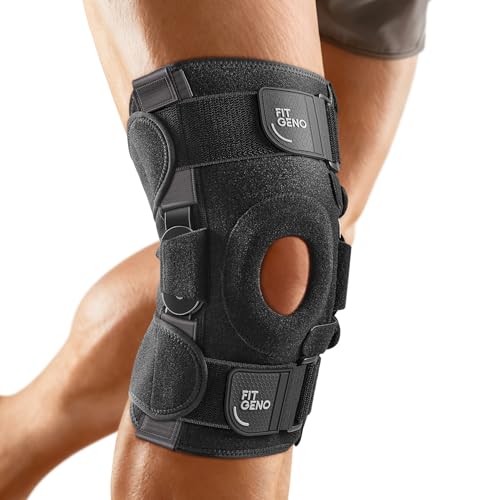
The Fit Geno is the cheaper alternative to the NEENCA above, and on paper the two are pretty similar.
You get a proper hinge on either side of the knee, an open patella and plenty of adjustment through the wraparound straps. It’s the kind of setup I’d look for if I wanted more support than a basic compression sleeve without jumping straight to something really heavy-duty.
It’s also fairly low-profile for a hinged brace. You’re still going to notice it more than a thin sleeve, but it doesn’t have loads of unnecessary bulk hanging off the sides. This is obviously super important under ski or snowboard pants – and was exactly why I stopped wearing my “prescribed” DonJoy brace after my last knee operation (more on that later).


The main thing I’d watch is sizing. The adjustment range looks generous, but the strap lengths and thigh-to-calf fit can be a bit awkward. I’d definitely measure your leg rather than just ordering your usual size.
The reason it sits below the NEENCA is mainly that I’ve got far more time on snow with the NEENCA and know exactly how it behaves after full days. The Fit Geno is still a good option if you want a similar hinged setup for less money.
Pros
- Proper hinges on both sides
- Plenty of adjustment through the straps
- Fairly low-profile for a hinged brace
- Cheaper than the NEENCA
Cons
- Sizing and strap proportions can be awkward
- Bulkier than compression sleeves
- I have much more on-snow time with the NEENCA
4. Bauerfeind Sports Knee Support Best Knee Sleeve
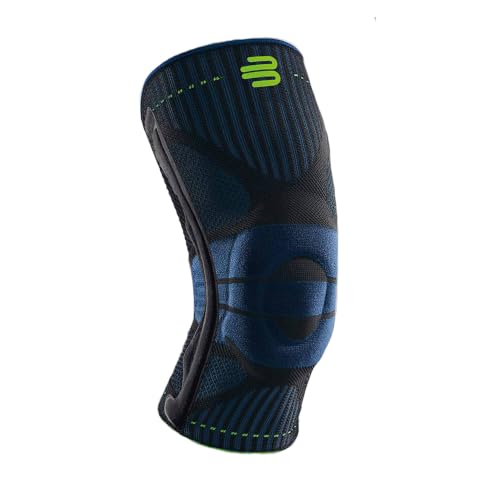
The Bauerfeind is expensive for what initially looks like a compression sleeve. But once you get your hands on one, it’s pretty obvious this isn’t the same thing as the cheap elastic sleeves you can pick up for twenty bucks.
I used this one when I wanted some compression and support without wearing a full hinged brace. That makes it particularly good for skiing and snowboarding because it disappears under snow pants far more easily and doesn’t get in the way when you’re flexing deeply or messing around with boots and bindings.

The knit itself gives you firm compression, while the padded section around the kneecap makes the whole thing feel more substantial than a basic sleeve. I also found it stayed in position really well, which is a massive deal for me. Nothing pisses me off faster than having to reach inside my pants and pull a knee sleeve back up every couple of runs.
Comfort is generally excellent, although you need to get the sizing right. This is a fairly compressive sleeve and I wouldn’t deliberately size down looking for more support. The silicone grip at the top does a great job of holding it in place, but it can also irritate some people’s skin during prolonged wear, so that’s worth knowing if you’re planning full days in it.


It obviously doesn’t give you the same lateral support as the hinged braces – though it does have supportive lateral “strips” which I tried to point out in the picture above. But that’s also not really the point. If I don’t need a full brace and just want compression, some extra support and something I can comfortably ride in all day, the Bauerfeind is great.
Pros
- Excellent compression without the bulk of a hinged brace
- Very comfortable under ski and snowboard pants
- Stays in position well while riding
- Integrated padding around the kneecap
- Easy to flex naturally in boots and bindings
- Premium construction feels noticeably better than cheap sleeves
Cons
- Expensive for a compression sleeve
- No rigid lateral support
- Fit needs to be spot on
- Silicone gripper doesn't suit everyone's skin
5. Shock Doctor Knee Brace Most Supportive

- Bilateral Support Hinges For Stability, Protection And Increased Performance
- N-Tex Air Flow Vented Neoprene, Provides Moisture Wicking Compression For Therapeutic Warmth And Healing
- Sbr neoprene, Polyester, Nylon, Rubber, Pu
- This product is not a substitute for medical care, seek professional medical advice for the diagnosis and treatment of pain, injury, or irritation
The Shock Doctor is another brace I know well. I used one when I first got back on snow after my ACL surgery, when I wanted something properly supportive while I rebuilt confidence in the knee.
It’s similar in concept to the NEENCA above, with hinges running down both sides of the knee and straps that lock everything firmly in position. The Shock Doctor feels a little more substantial, but the difference isn’t massive. Both are proper hinged braces rather than lightweight sleeves.
Once everything is lined up and tightened properly, it feels very secure. The X-shaped straps wrap across the hinges and do a good job of keeping the brace planted when you flex your knee, while the stretch mesh behind the knee stops it feeling ridiculously restrictive.


It is still fairly bulky. You’ll notice it under your snow pants and it’s definitely warmer and heavier than something like the Bauerfeind. The strapping also takes a little longer to get right than simply pulling on a sleeve. But that’s pretty much the compromise you make with any brace like this.
These days I’d probably take the Fit Geno or NEENCA for most of my riding. They give me enough support in a slightly less substantial package. But if you want something a little beefier and maximum support is your priority, I’d go with the Shock Doctor. I rode in this when I was getting back on snow after ACL surgery and it gave me exactly what I wanted at the time: a secure, supportive brace that I could actually ski and snowboard in.
Pros
- Excellent support from the bilateral hinges
- X-shaped straps hold it securely in position
- Feels very solid once properly adjusted
- Good option if you want a more substantial brace
- Still allows good knee flex for a hinged design
- One I've personally ridden in after ACL surgery
Cons
- A little heavier and bulkier than the NEENCA
- Much more noticeable than a compression sleeve
- Straps take a little time to get dialed in
- More support than many riders will actually need
Watch the Video Version
Using a Knee Brace for Skiing & Snowboarding
Get the Fit Right!
A good knee brace with a bad fit is pretty much useless. Trust me. Too loose and it’ll start working its way down your leg. Too tight and you’ll spend the day dealing with pinching and pressure points.
Don’t just order your normal clothing size. Measure your leg exactly where the manufacturer tells you to, because annoyingly they all seem to do it slightly differently. This matters even more with hinged braces, where you also want the hinges sitting in the right place either side of your knee.
I normally get everything roughly set up at home, do a few deep knee bends and then make the final adjustments once I’m actually riding. Something can feel absolutely fine standing around in your living room and then start annoying the hell out of you after twenty minutes on snow.
The aim is snug enough that it stays exactly where you put it, without cutting in or restricting your normal riding position.
Can You Wear a Knee Brace Under Snow Pants?
Yep. That’s how I wear mine.
Compression sleeves are easy because they add almost no bulk. Hinged braces obviously take up more room, but I’ve never found that to be a major problem unless the pants are particularly tight around the knees.
I did have issues with some of the larger DonJoy “exoskeleton” style braces, which I wouldn’t recommend for skiing or snowboarding FYI. They’re seriously hard and solid, which isn’t something I particularly want strapped to my knee when I crash.
I usually wear the brace over a thin base layer rather than directly against my skin. It’s more comfortable for a full day and also gives you a bit of separation from straps, hinges and silicone grippers.
Before heading out, get your boots and pants on and do a few proper deep knee bends. Make sure the brace doesn’t catch on your pants, dig into the back of your knee or start shifting around as you flex.
If it’s already annoying you in the hotel room, it’s going to enrage you halfway through a powder day.
Do You Need a Different Knee Brace for Skiing and Snowboarding?
Not really. I use the same knee braces for both skiing and snowboarding. A good hinged brace doesn’t suddenly become a snowboard brace because you strap into a board instead of skis.
The main difference for me is impact protection. Snowboarders spend more time dropping directly onto their knees, particularly when learning or riding hard snow, which is why I rate the padded Demon option so highly. For skiing, I’m generally more interested in support, fit and whether the brace stays put through a full day of flexing the knee.
I also tolerate the rigid DonJoy Armor-style braces much better for skiing than snowboarding. The rigid frame bothers me less with the more straightforward flexion and extension of skiing than it does with the more turned-out stance I use on a snowboard. I’ve also landed directly on one snowboarding before and it freaking hurts.
The Armor used to be one of the best knee braces for skiing in my book, but at around $500 it’s become pretty hard to recommend. DonJoy also makes the Bionic FullStop, which gives you a serious hinged brace without the same huge rigid frame and costs considerably less. I’d still take one of my picks above, though.
Either way, I’d choose based on what your knee actually needs rather than whether the box says ski or snowboard.
What a Knee Brace Can and Can’t Do
A knee brace can make a huge difference to how confident you feel on snow. After blowing my ACL, I spent a long time thinking about my knee every time I rode.
Every awkward landing. Every patch of chopped-up snow. Every time the board got pulled somewhere I wasn’t expecting. You become ridiculously aware of a joint you previously never gave a second thought to.
Wearing a proper hinged brace helped me get past some of that. My knee felt more supported and, probably just as importantly, I stopped obsessing over it quite so much. I remember realizing halfway down runs that I hadn’t thought about my ACL once. That felt like a pretty big milestone.
But a knee brace doesn’t give you a new knee. It doesn’t rebuild your quads, fix a bad injury or give you permission to ride through a knee that’s suddenly swollen, unstable or properly painful.
I still had to do the boring stuff: rehab, strength work, gradually building up my riding and occasionally accepting that my knee was telling me to stop being an idiot.
These days I don’t automatically reach for the biggest brace I can find. Sometimes I want a hinged brace, sometimes a compression sleeve is enough, and sometimes I just want the Demon pads because smashing a previously operated knee into hardpack fucking hurts.
Use a brace as a tool, not a force field. Get the support or protection you actually need, make sure it fits properly, then hopefully forget about the damn thing and go riding.
Final Thoughts
Every knee is different, and what works brilliantly for one person might feel awful for another. The important thing is finding something you’ll actually wear. A knee brace sitting in your boot bag because it annoys the hell out of you isn’t much use (I’m at half a dozen of these already).
I’ve tried everything from basic compression sleeves to those massive exoskeleton-style braces over the years. These days I’m much less interested in strapping as much hardware as possible to my leg. I just want enough support or protection for what I’m doing, without thinking about my knee every turn.
And I think that’s probably the best sign you’ve found the right one. You put it on in the morning, go riding and mostly forget it’s there.
My knees have given me enough grief over the years. I’d much rather spend the day worrying about finding powder, where we’re stopping for lunch and whether I can get away with one more run before picking the kids up.
See you out there.


Great article and advice. Thanks!
Thank-you, much appreciated 🙂
Have an epic season!
Thank you for the valuable advice! I just had a mild meniscus tear and thought my skiing days are over, but am going to purchase the recommended one, hopefully it works. Happy skiing!
Hey Kaisa,
No problem – been there. Hope it helps!
Mike
Great article. Appreciate the time and effort you have put in to help other skiiers. I am going with your recommendation for the Neenca hinged.
Kevin, UK
Thanks Kevin, sadly one of the things a lot of us have in common. Hope your own “knee journey” is going well. BW, Mike
What do you recommend for knee pain when bending like squats? I need support to take some load off the knee.
Hey Robert, where about’s is the pain? Prior to my “proper” injury, I had this on/off and it turned out to be patellar tendonitis. I actually found that a “patellar strap” worked a bit better for this. Ultimately the route for most knee pain is strengthening and physio, but obviously knee braces are a good adjunct to keep us skiing in the interim. Thanks, Mike
Thanks Mike, interesting article. I’m wondering… Is the best knee brace for skiing the same thing as the best knee brace for snowboarding? I do both (though not particularly well). I’d rather get one option as I sometimes switch codes on the same trip or even day. I haven’t done my ACL or anything, but my knees are increasingly problematic. I have some pre-season physio to do but they also recommended looking into braces, hence why I’m here. TIA
Thanks Sam – good point, I’ll add a section to the article. I do use the same one for both disciplines. Skiing braces are sometimes a little firmer, like the Donjoy exoskeleton style. These make really good knee braces for skiing but not as good for snowboarding (because of the way you tweak and bend your knees – and also the risk of falling onto them is higher in snowboarding). Anyway, I’ll add the specifics to the guide. But any of the ones listed here is totally viable for either sport. Hope that helps!